1. Biomass Availability
Assess the realistically available biomass quantity after seasonality, existing use, competing demand, collection losses, quality variation and supplier reliability are considered.
The purpose is to discover what can stop the project, what can be corrected and what must be verified before capital is committed.
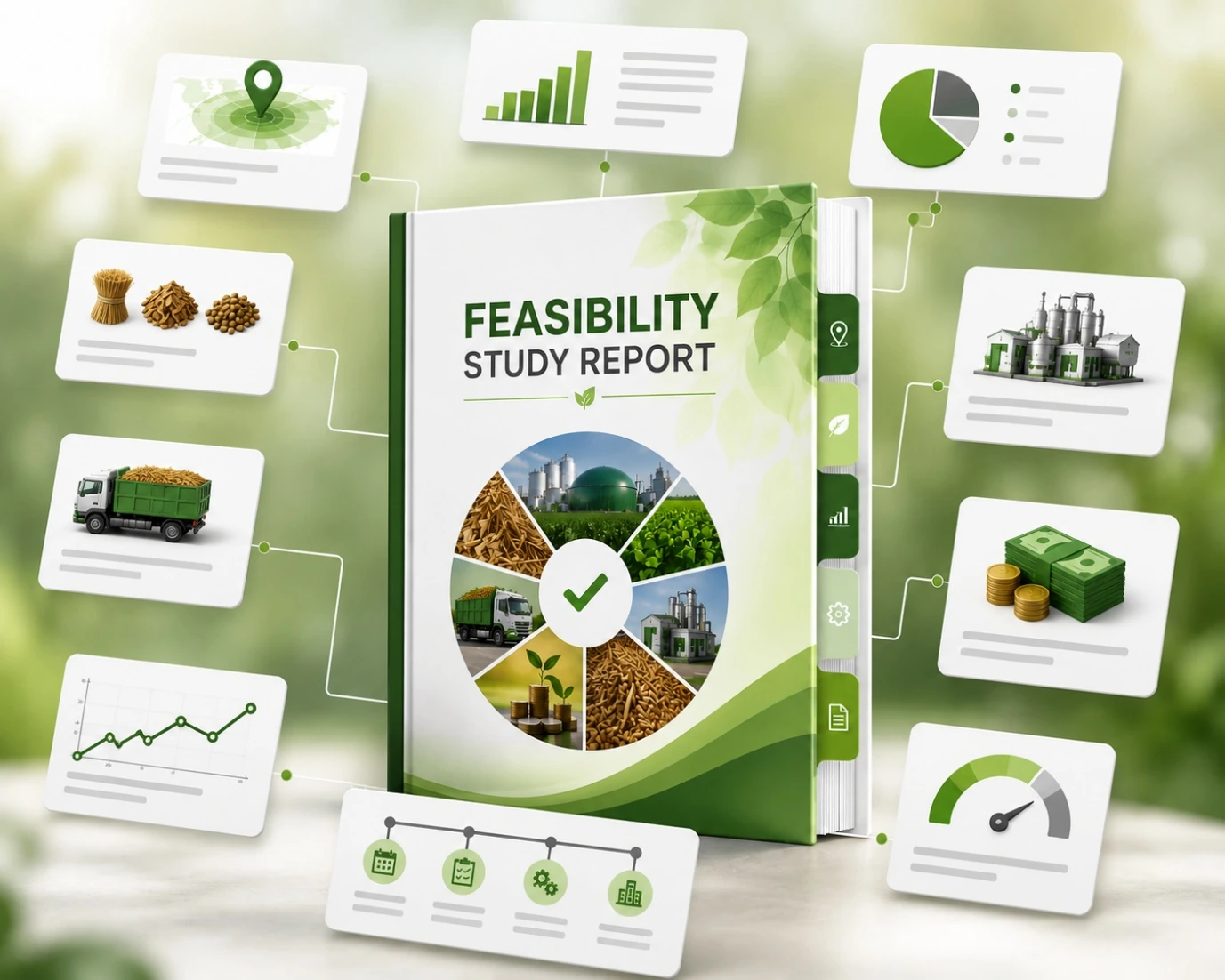
We begin with the proposed capacity, location, product and buyer route, then work backward to the physical and commercial conditions required to support them. The study is valuable when it can challenge the promoter’s preferred answer.
The final recommendation is framed as Go, Modify or Hold, with explicit conditions. A technically possible plant may still need a different capacity, feedstock mix, site, funding structure or market strategy.
Assess the realistically available biomass quantity after seasonality, existing use, competing demand, collection losses, quality variation and supplier reliability are considered.
Evaluate whether the proposed site has suitable road access, utilities, storage space, safety conditions, material movement area and scope for future expansion.
Test whether biomass can be collected, aggregated, transported, handled and stored reliably within a commercially workable procurement radius and delivered cost.
Check whether the selected biomass characteristics are compatible with the proposed technology, preprocessing, drying, size reduction, feeding and production process.
Validate the target market, buyer requirements, product specifications, expected demand, pricing basis, delivery conditions and realistic sales route for the proposed output.
Model CAPEX, OPEX, working capital, production assumptions, selling price, profitability, debt servicing and sensitivity scenarios to understand whether the project remains financially viable under realistic conditions.
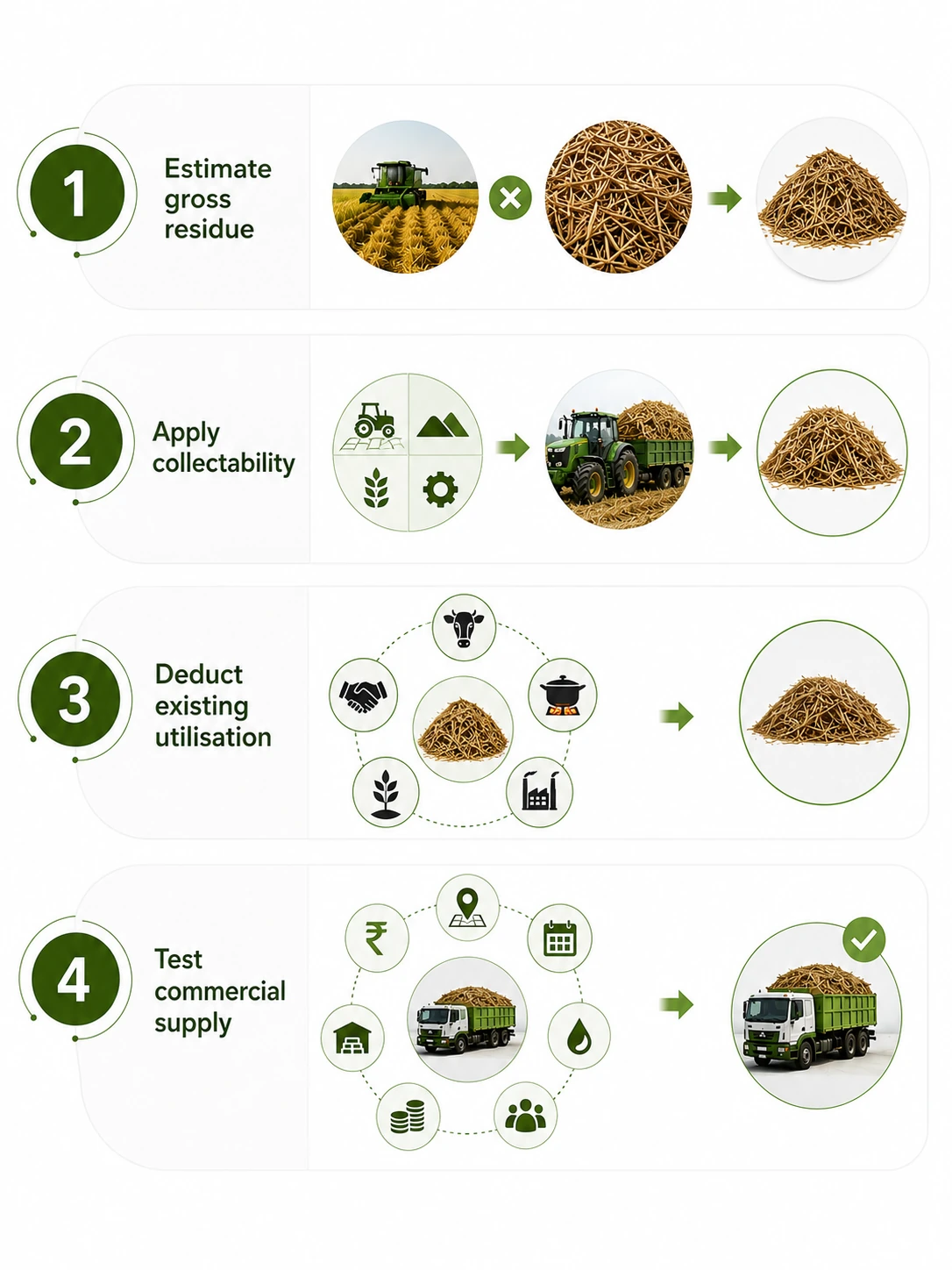
District-level residue estimates are useful for orientation, but they are only the start. A commercial plant depends on the fraction that can be collected, purchased, stored and transported at the required quality when the plant needs it.
What fraction can be practically recovered from fields or industrial sources?
What is already used for fodder, fuel, soil retention, briquetting or other applications?
Who will aggregate it, at what seasonal price, advance requirement and delivery commitment?
What moisture, contamination, storage loss and preprocessing burden reaches the factory gate?
The opportunity is sufficiently supported, subject to named pre-commitment actions.
Reduce or alter capacity, site, feedstock mix, product, funding or execution assumptions.
Critical evidence or economics are too weak to support the next irreversible investment.
Obtain samples, buyer confirmation, supplier contracts, land data or revised quotations before deciding.
Share the proposed location, product, capacity and the decision deadline you are working toward.