What are we committing to?
Project scope, capital requirement, operating assumptions, risks, return expectations and the sequence of decisions still pending.

The document starts where feasibility ends: key assumptions are sufficiently validated and now need to become a coordinated execution plan.
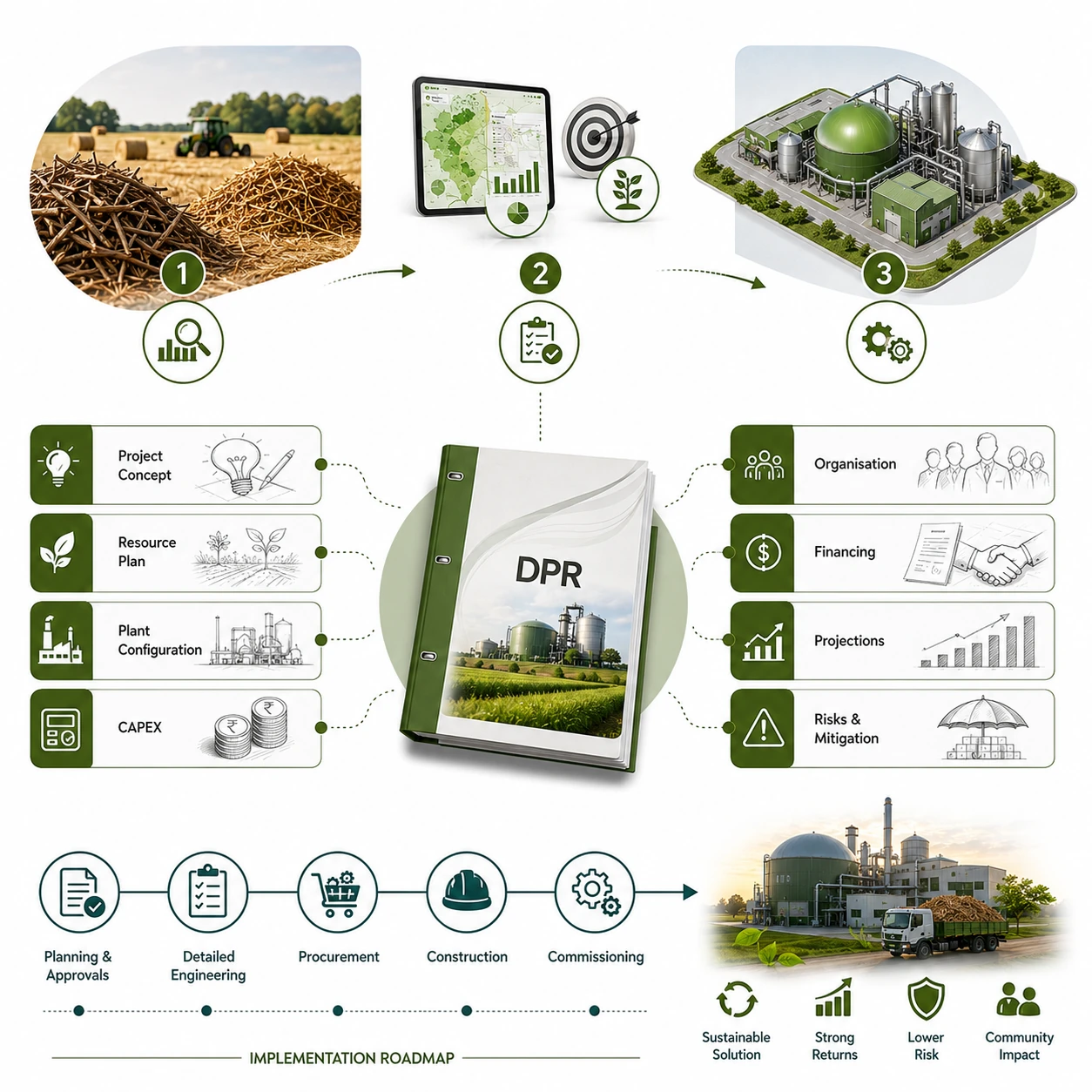
A DPR becomes useful after the basic project choice is reasonably stable: proposed site or site criteria, product, capacity, resource strategy, target market and a defendable investment basis.
Where these inputs are still moving materially, the right first step is additional validation. Otherwise every downstream table—from machinery to debt service—keeps changing and the DPR becomes a collection of provisional numbers.
Project scope, capital requirement, operating assumptions, risks, return expectations and the sequence of decisions still pending.
Means of finance, repayment, working capital, projected statements, DSCR and the assumptions behind cash generation.
Accepted feedstock range, product quality target, rated capacity, utilities, interfaces, performance expectations and exclusions.
Approvals, procurement, civil and utility dependencies, staffing, trial production, commissioning and control milestones.
Promoter objective, location, product, capacity, operating philosophy and project boundaries.
The resource strategy and customer route that the plant design must serve.
Process flow, equipment, utilities, storage, quality controls and production assumptions.
Installed cost, pre-operative requirements, working capital, promoter contribution and debt structure.
Revenue, costs, statements, debt service, returns and sensitivity tied to approved assumptions.
Approvals, organisation, timeline, dependencies, risks, mitigations and responsibility map.
During financing and procurement, assumptions often change. The platform keeps section status, client change requests, approved financial snapshots and version history connected so the final export reflects an authorised project basis.

Share the available feasibility work, quotations, financing assumptions and intended use of the DPR.